National Assembly adopts law amending and supplementing several articles of 10 laws related to security and order
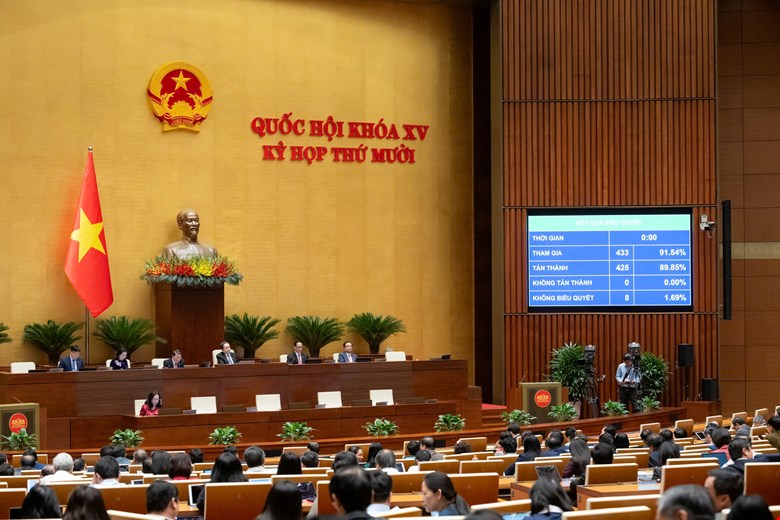
The National Assembly (NA) adopted the Law amending and supplementing several articles of 10 laws related to security and order, with an overwhelming majority of deputies voting in favour, on the morning of December 10, 2025.
11/12/2025
00:00
The law consists of 11 articles and will take effect from July 1, 2026.
Presenting a report to the NA, Minister of Public Security General Luong Tam Quang stated that, regarding the Law on Security Guard, the Government proposed expanding the list of individuals eligible for guarding, and supplementing provisions on security guard measures to ensure alignment with the Politburo’s Regulation on the positions and leadership titles in the political system.
Regarding the Law on Entry, Exit, Transit and Residence of Foreigners in Vietnam, the Government supplemented provisions to grant visa incentives to high-quality digital-industry foreign personnel and other groups eligible for preferential treatment under relevant laws, resolutions of the NA and resolutions of the NA Standing Committee.
As for the Law on Residence, the Minister noted that amendments now allow children under six years old to register permanent residence at a lawful residence not owned by them when living with their parents or lawful guardians, which aims to protect the property rights of the lawful homeowners of the residence as well as the rights of children under six.
For the Law on Identification, the Government added the provisions authorizing the Government to prescribe the roadmap and deadlines for the connection and sharing of data with the National Population Database, which requires involved agencies to finish the connection and data integration.
The Minister affirmed that the Government had conducted an intensive review of the supplements and amendments to all 10 laws related to security and order to ensure consistency with the restructured political system and the two-tier local administration model, while fully institutionalizing breakthrough policies on science and technology development, innovation, national digital transformation, decentralization and administrative procedure simplification in alignment with the broader legal system.
Print
Chia sẻ
Latest news

Most read news of the week

Immigration Department launches Pre-arrival Information System
13/05/2026
Deputy Minister Nguyen Van Long commends police units for busting network of illegal military weapon production and trafficking
16/09/2025
Deputy Minister Pham The Tung praises Thanh Hoa Provincial Police Department for dismantling major fraud group
24/03/2026